la paarantii kaayash ooshchi
Ancestry
European Roots
Don’s maternal and paternal lines are rooted in Germanic Europe. His father was born in Germany, but his mother is first generation Canadian and her line has been traced to Scotland and Norway. Family research continues.
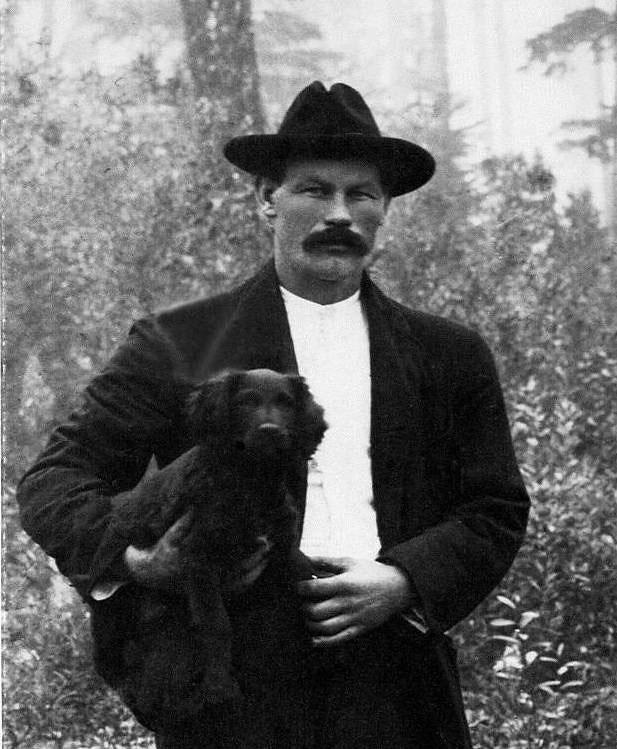
Ole Watland, is a Norwegian immigrant of Don’s maternal ancestry.
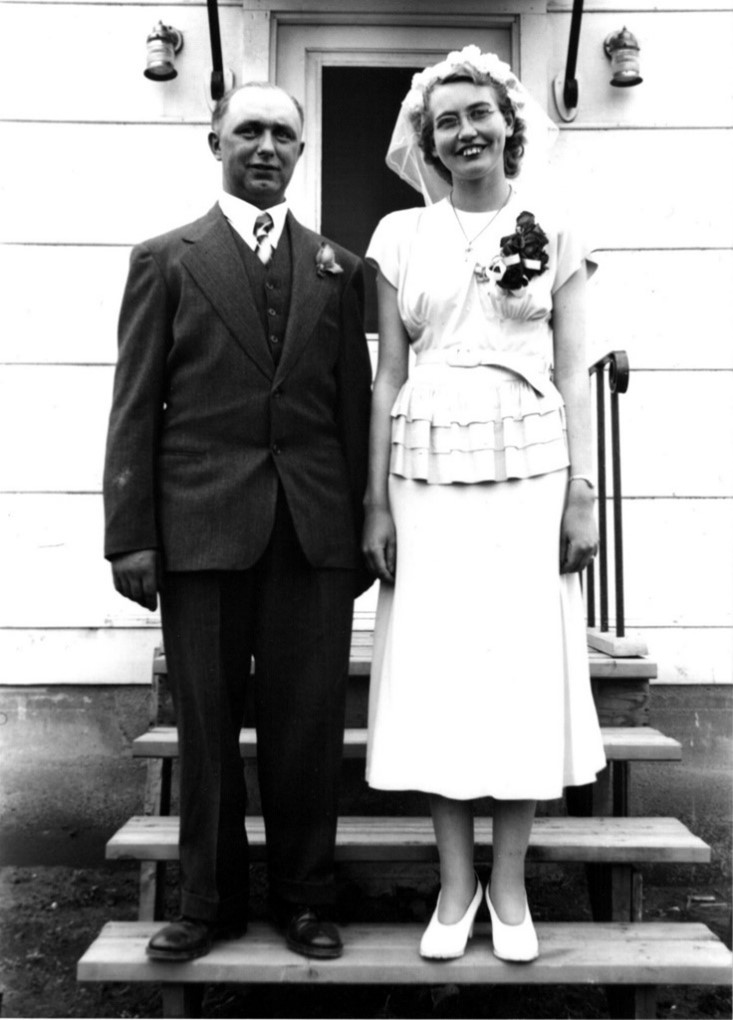
Agnes Watland and Albert Henke wedding.
Anita’s paternal great-grandfather immigrated from Hussenbach, Russia, 1899 (G. Glowachuck 2008) and her paternal great grandmother was from the British Isles. Her maternal ancestral line has been traced to French Courier de bois, Jean Magnan dit L’Esperance (1640) and his wife Marie Moitié (1643 – 1727), who were born in France. Their son, Antoine Magnant dit L’Espérance and his Anishinaabe born country wife Elizabeth started a long Métis line of descendants: two of whom are in Canadian history books.
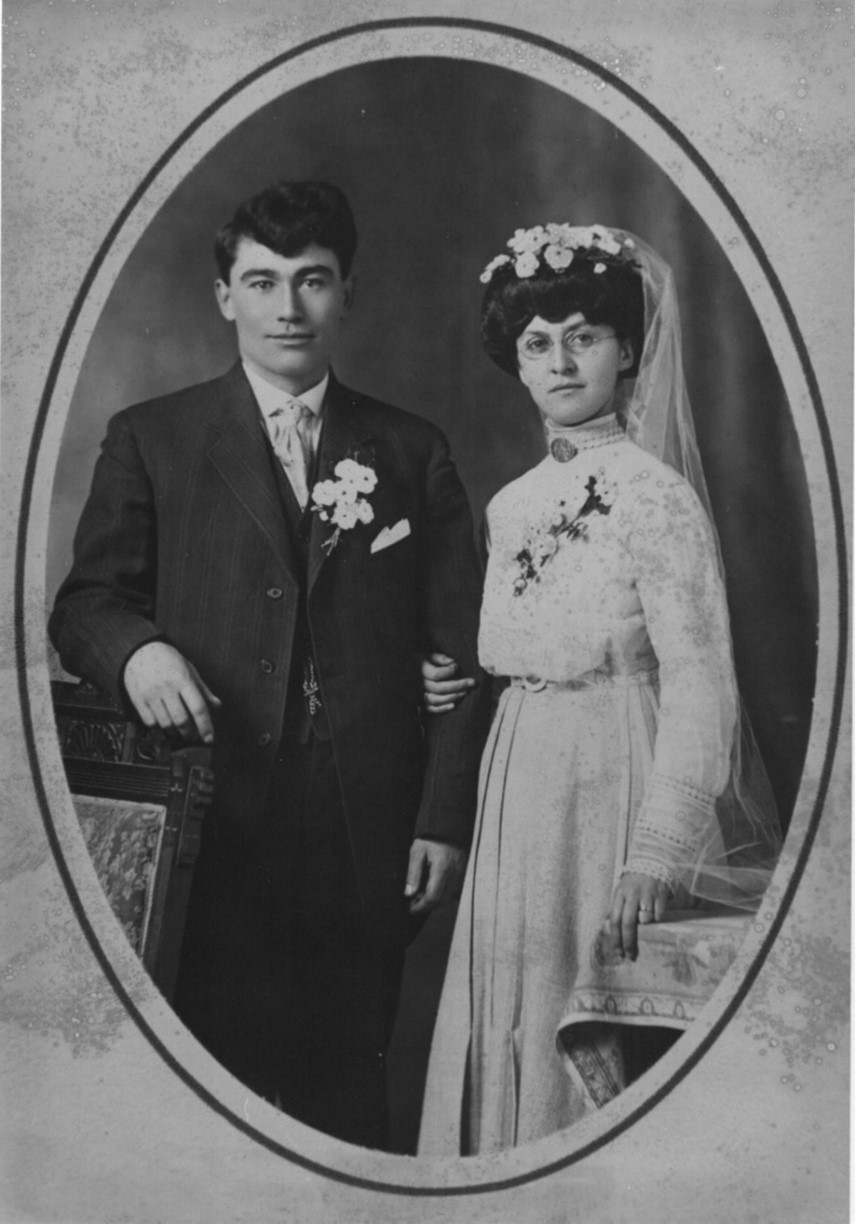
Rose Schmidt and Guillaume Boyer wedding, 1912.
Michif Taanday Ooshchiiyen
Métis Heritage
Alexis Bonamie dit L’Esperance was Elizabeth’s great-great-great grandson. He was born in 1796 and drafted into the military at age 16 to fight in the War of 1812. The Montreal Department of the HBC hired him four years later for the position of oarsman on a York Boat crew. According to Hudson’s Bay Company Archives when he retired in 1835 the Company granted him 50 acres at the Red River Settlement. He continued to work for HBC seasonally as steersman on the Portage La Loche Brigade until 1870. According to John Peter Turner (1943), Alexis worked as a guide for Governor George Simpson on his 1828 expedition down the Fraser River to the west coast.
Alexis’s grandson Louis Schmidt was childhood friend, schoolmate and first secretary of Louis Riel the Métis Provisional Government. Lesser-known facts regarding Schmidt: In 1870 he became Hon. Member of the Legislative Assembly of Assiniboia; he was a freighter, negotiator, writer, teacher, land agent, and founding member of l’Association catholique franco-canadienne de la Saskatchewan.
Anita’s maternal First Nations lines include Innu, Ojibwe, Saulteaux and Cree.
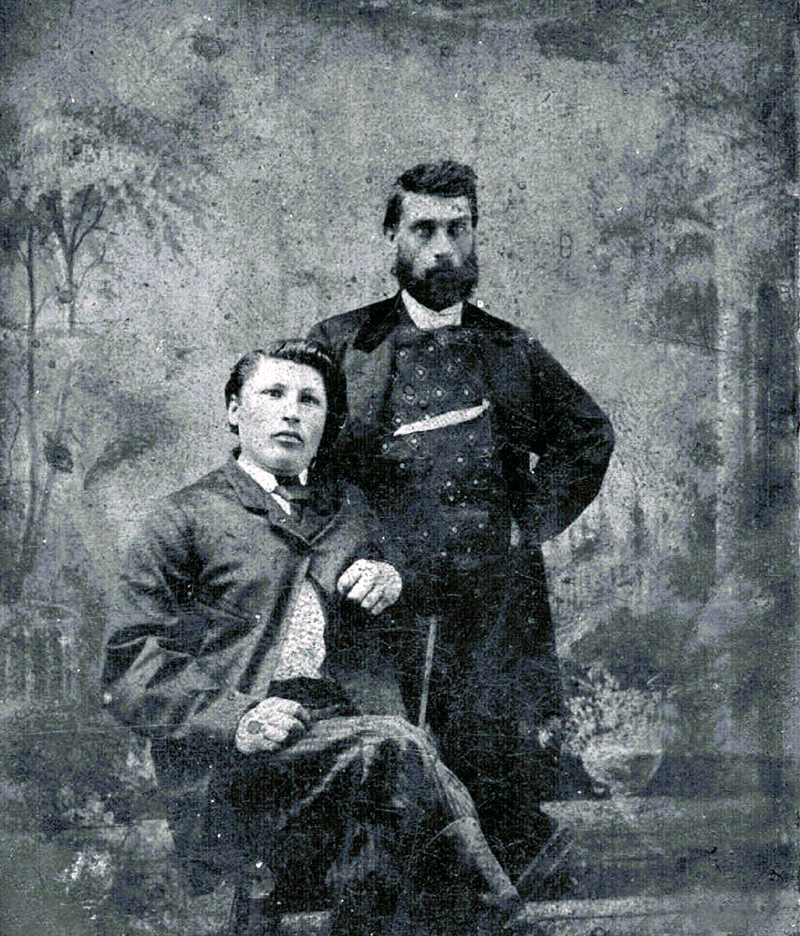
Louis Schmidt (sitting) and his stepfather Pierre Laferté circa 1858.
Awwaana ki Michif
Who are the Métis?
Métis are one of three Indigenous groups in Canada. They are a people of mixed ancestry: First Nations and European. When Europeans colonized the New World, First Nations women were often taken as ‘Country’ wives: this initiated the creation of a new people. The children of those loose marriages became the first entrepreneurs in North America. With their understanding of Colonial and First Nations cultures, they were also gifted in speaking multiple languages. Like all good business people, they created a universal trading dialect called Michif, which is a combination of Cree and French, with a few English words thrown in.
Taanboor / The Drum
Drums are not instruments but people: And they are female because of their connection to the earth. All of the materials used to make the drum come from the earth, so when played, the drum reminds the player of their responsibility for the conservation and health of Mother Earth. The heartbeat of Mother Earth was the first sound in the world and the drum recreates her heartbeat. The rhythm heals as it restores emotional, mental, physical and spiritual existence because Creator revolves around the rhythm. As well, because drums are human. As well, drums must not be hammered aggressively, because it is analogous to ‘beating’ someone and should not to be touched by anyone but the owner without the owner’s consent.
Aen Yyayloon / The Fiddle
The fiddle has been in Europe since the Middle Ages and during the ‘Age of Discovery’ was brought to Canada by Scottish and French immigrants. It was popular with Métis, mixing the beat of the drum with their own rhythms and unique beats.
Of course, many individuals could not afford such a lavish instrument, so they made their own out of birch and maple. Every family had (s) a fiddle player and there was always enough room to do the jig.
La Jig di la Rivyayr Roozh / The Red River Jig
Originating from the Red River settlement area, the first reference to it was in 1860, during a Métis wedding celebration. It is a combination of the Scottish Highland dance, First Nations dances and French-Canadian, integrating jig, quadrille, and reel steps. Popular dances were (are) the Broom Dance, Sash Dance and the Red River Jig.
The Broom Dance was performed by many bachelors. Dance partners were not always available, but there was usually a broom close at hand. Whereas, the Sash Dance is comparable to the Highland Sword Dance, but using a sash instead of a sword. The famous Red River Jig footwork was taken from Plains First Nations dances and adding stomps to the performance. A good dance caller and fiddle player could keep the party going till morning.
Sayncheur flayshii / Métis Sash
In the weave of the Métis sash, there are six colours: all of which have cultural significance:
Roozh/Red is the most prominent colour and it represents the lives lost and the blood that flowed for home, country and rights. It also stands for their strength – Métis people are still here today.
Ver/Green represents the fertility of the womb and the birth process on Mother Earth. Denoting the gifts that have been given to us by the land and by the life givers, aka women.
L’orr/Gold signifies prosperity and resilience of Métis. Their resilience through trauma strengthens their motivation to entrust a rich cultural heritage to future generations.
Bleu/Blue represents spirituality, our connectedness to one another, the “all my relations” part of prayer.
Blaan/White our connection to Creator, land, sky and water.
Nwaenr/Black thread represents colonization. The loss of our culture, ways of life and many lives. People have been on this land for thousands of years, and will be here for many years after us. It is a small part of history and our story is not finished.
Sashes were a very important piece of clothing for Métis. It was originally used by Voyageurs (French Canadians) in the fur trade. Known as un ceinture fleche (Assumption sash) it was later adopted by the Métis. They are hand-woven pieces of art with practical uses. They served as first aid kits, keyholders, ropes, washcloths and towels, bridles and saddle blankets. And the fringes at each end were used as emergency sewing kits. Today, it is used for ceremonial adornment and to demonstrate pride Métis culture and heritage. Traditionally it was worn about the waist and some women now wear it over the left shoulder to identify their marital status.
La Rilizhyoon / Spirituality
Many individuals adopt the lifestyle of First Nations. Every aspect of everyday life is a part of nature: reverence to the Creator, his creations, and Mother Earth’s ability to maintain it, are of utmost importance. All species are equal persons – far removed from Judeo-Christian beliefs that ‘man has dominion ‘over the earth’…
Many individuals adopt the lifestyle of First Nations. Every aspect of everyday life is a part of nature: reverence to the Creator, his creations and Mother Earth’s ability to maintain it, are of utmost importance. All species are equal persons and prayers are always finished with ‘All my Relations’.
Taanday kawiikihk/Mail
P.O. Box 72,
Traytown, NL A0G 4K0
Ooshipayha/Email
anita@poorlimoond.ca
djh@poorlimoond.ca
PLEASE NOTE we prefer to be contacted using emails and text messages. We are diligent in checking for messages and we will get back to you as soon as we are able.